Sunday, June 29, 2025

Father of Sunsets+ --- Days 14/187 & 188

Walks: Hood, Sloat Garden Center

Distances: 5.5, 3.5 miles


Claude Lorrain (Fr. working in Italy, 1604/5-1682), Seaport at Sunset, 1639

Claude Lorrain, View of Tivoli at Sunset, Oil on canvas, 1644 39 1/2 x 53 1/2  

So, if the artist Claude Lorrain had called himself a landscape painter at the beginning of his career, it would have been a very short one indeed.  In his era 'landscape' was simply the outdoors one had to toil in or contend with and paintings of it were among the least prestigious.  History painting was the thing so he invented historical people engaged in historical activities surrounded by classical architecture.  And placed them in front of his real subject: idyllic landscapes illuminated by atmospheric, radiant skies. 

And, within just a few years, he had singlehandedly elevated the prestige, collectability and popular enjoyment of landscape art.  This was not coincidental and the look of his art wasn't a 'schtick' to sell. He deeply loved nature, felt compelled to portray its beauty and needed to invent techniques to do that.  According to his fellow painter, Sandrart, Lorrain would lie out in the fields from dawn to dusk storing up the visual effects of light in his brain. Then, he would make ink and chalk studies on paper, bring them back to his studio and work alone to complete the complex and costly process of making a large, detailed landscape.  This intensely personal relationship between artist and subject resulted in works that have a simple honesty filled with an almost religious belief in the beauty of nature.  

And spoke to the public.  He became highly collectible by those mostly upper class, mostly affluent, mostly English young men undertaking their rite of passage 'Grand Tour.' Of these there were many; they traveled through Europe, typically accompanied by a tutor or family member, with the Italy the prime taste educational destination. And many of those young men returned home with a painting by the artist already known by the prestigous one name:Claude.

In fact Claude paintings became so popular they were subjected to many forgeries.  To defend against this and to ensure he, not forgers, got the monies and recognition due, he produced the "Liber Veritatis." Defined "Book of Truth," it contains drawings that detail nearly 200 of his compositions on canvas. Residing in the British Museum it has been invaluable in authenticating Claude's work over the decades.  But it may be even more important as a means of bringing Claude's landscape techniques before developing artists. The prints made from the book were increasingly detailed so that drawing teachers began recommending them for copying thus influencing the development of future landscape artists and furthering the acceptance of landscape as a worthy subject of its own.

Claude's art had enormous influence on English landscape architecture in the eighteenth century as well.  Many of its manor houses were surrounded by parks specifically designed to look like Claude paintings.  The style came to be called 'picturesque landscape,' and none fit the description better than the English manor, Petworth, where the renowned J.M.W. Turner was a frequent visitor.  Turner revered Claude's work, and over a century after his death, took Claude's sunsets to new levels of atmospheric luminosity.
 
J.M.W. Turner, (English, 1775-1851), The Lake, Petworth: Sunset, fighting Bucks, ca 1829


Petworth interior with Turner paintings

Then another Claude - Monet - who encountered Turner's art and sunsets during a brief exile in London and returned to them several times later, took them another step into Impressionism, now the most beloved of all art styles

Claude Monet (Fr. 1840-1926), Sunset on the Seine at Lavacourt, Winter Effect, 1880

Friday, June 27, 2025

Flat as a Racetrack --- Days 14/180 - 186

Walks: Lots of indoor things to do this week

Distances: 2.5 average


Not for those who don't like gazing at beautiful stars and cars or feeling the beat of jazzy music, or jetsetting to the glitzy, ritzy Formula 1 worlds around the world.  But if you're okay with all those things, then, like Ciwt, you'll overlook the bald tire thin plot and just enjoy your big screen experience. 

Saturday, June 21, 2025

Everyday Art --- Day 14/178 & 179

Walk: Civic Center, AMC Kabuki 8 (The Life of Chuck)

Distance: 4.5 miles, 3.5 miles


 The Life of Chuck is touching poetry in the most prosaic of packages.  You might like it (as Ciwt  did) if you too like poetry and/or Stephen King (and are a bit older). Otherwise....

Thursday, June 19, 2025

Bouquets to Ciwt --- Day 14/177


Walk: Hood Brunch

Distance: 3 miles


So yesterday's photo shoot crew thanked Ciwt with some pretty and artistic bouquets.


Wednesday, June 18, 2025

Film Location, Location, Location..... --- Day 14/176

Walk: TJ's, LP Nails

Distance: 5 miles

So, a young designer friend asked if she could use Ciwt's home as location for a photo shoot.  Thinking it would be a quick in and out and fun to observe, Ciwt said sure.  

Yesterday was the day; things started arriving.  Maybe 10 enormous totes with home accessories (most with $$$$  price tags),


coffee table size books, 3 or 4 tubs of flowers and then hundreds of pounds of professional camera equipment.


Altogether there were four people on the crew and by now Ciwt had realized they weren't there for a quick cameo.

At first Ciwt was interested as she watched her pictures being removed from the walls and many of her things being moved or replaced by the $$$$ accessories, books and flowers.  And the shots being lined up and lit.  


And lined up and lit again. And again, then discussed and lined up again. Still no actual photo taken.


As her readers might imagine, the fun was slowly fading for Ciwt who went out to do errands. She returned home to more lining up and lighting. So she left again to fill her time with more errands.  Then for her nails appointment.  Finally, at the very end of the day, the team restored her home to its original arrangements, throughly cleaned up and left Ciwt reading on her window seat. And so happy she is not a movie star who has to endure this slow, exacting filming process months even years at a time.  

Monday, June 16, 2025

This is Winter --- Day 14/175

Walk: Monday errands

Distance: 3.5


Julian Fałat (Polish, 1853-1929) , Winter Landscape with River and Bird, 1913, oil on canvas, National Museum in Warsaw, Warsaw, Poland.

Ciwt is so steeped in the art and artists she is steeped in she forgets she has never encountered great artists and works from other countries.  Until she more or less stumbles on them in her travels.  Like this incredible painting that utterly captures the clear, cold, silent solitude of winter.

Winter in rugged, river filled Poland to be exact.  It was painted by one of Poland's foremost landscapists and champion of his beloved Poland and Polish art, Julian Falat.  After literally traveling around the world from his homeland (even briefly to San Francisco) and accepting an invitation from future German emperor Wilhelm II to serve as court painter in Berlin (1886-1895), he returned wholeheartedly to Poland.  There he became director of the Krakow School of Fine Arts where he had studied, and painted prolifically, concentrating on hunting scenes, portraits, travel observations, and most especially Polish landscapes.

Fałat declared: "Polish art ought to convey our history and beliefs, our good qualities and our defects; it must be the quintessence of our soil, our sky, our ideals."[1]


Julian Falat, Salf Portrail, 1896, o/c


Fałat died in Bystra Śląska on 9 July 1929. A Polish museum, the Fałatówka, is devoted to him.


Sunday, June 15, 2025

El Indominable --- Days 14/172, 173, 174

Walk: AMC Kabuki (The Phoenician Scheme), Sunday Hood

Distance: 3.5 miles, 3 miles

Domenikos Theotokopoulos, called El Greco (crete, active in Spain), 1541-1614, Saint John the Baptist, ca 1600, oil on canvas

Ciwt has no doubt the tabloids would be replete with stories of his exploits if the painter El Greco was alive today.  

Born Domenikos Theotokopoulos in Crete in 1541, and trained as an icon painter, he could have had a satisfactory artististic life in that sought after speciality.  But his youthful ambitions were larger, so he set off for Venice and from there the thriving and competive artistic hub of Rome.  In Rome he worked and learned in the studios of the great Renasissance masters (Tintoretto even Michelangelo) eventually becoming a disciple of Titian.  But here again in Italy his ambitions were thwarted, this time by a lack of important commissions.  So, in his mid 30's he departed for Spain to seek work at the court of Philip II, then the most powerful monarch and patron in Europe.

Philip II though turned out to be at odds with the stylistic techniques the artist had developed and insisted on - the clashing colors, disquieting emotions, elongated figures.  These offended Philip's aesthetic and religious views so he refused patronage.  

The ambitious artist's response to Philip's rejection was to become the iconic and controvesial artist, intellectual and flamboyant businessman, popularly dubbed El Greco.  The very techniques and personal religious views that alienated Philip were embraced by the clerical elite and intellectuals of Toledo. They clamored for his company, commissions for his work abounded and El Greco became El Greco.

With such reliably powerful patronage he was free to work from his own philosophical, technically masterful, personally expressive and some say "arrogant" genius. In other words El Greco was free to flourish. And flourish he did, establishing a large workshop and living in a 26 room mansion often with a full orchestra playing as he dined.  And with incessant lawsuits.  Learning that artists in Spain were paid the wages of ordinary tradesmen like brick layers and carpenters, El Greco would have none of it and began setting and demanding his own prices.  Those who were unwilling or slow to pay - and there were many - were dragged to court and sued for all the monies owed him.  Ciwt can only guess at El Greco's other behaviors and the level of his notoriety throughout Spain.

El Greco's famed highly idiosyncratic style is on full display in the above painting of John the Baptist commissioned by the Descalaced (Barefoot) Carmelites in Malagon, Spain..  Perhaps the cousin of Jesus, John is a central figure of Christianity and a worthy and oft-painted subjecr of El Greco - with this one in the Legion of Honor arguably the greatest.  An Old Testament messianic preacher/prophet/zealot, John is said to have wandered the wild landscapes of the hill country around the Dead Sea heralding fire and brimstone messages.  He is best known for baptizing penitents, declaring Jesus the Lamb of God and baptising him and then for his infamous beheading by King Herod at Salome's (Herod's stepdaughter's) entreaty.

With or without knowing Saint John's story, viewers of the painting easily perceive a man who lived an emotionally agitated, vulnerable, sorrowful but spiritually driven life.  El Greco's deliberate elongation of Saint John, his freewheeling, daring perspective, distortions, audacious use of flickering colors,  the entire canvas really, emphasizes John's austere, aesthetic, religious nature. The agitated sky, broken brushstrokes convey John's fervor and nervous, spiritual energy. El Greco has created an entirely personal, original and enduring artistic shorthand.  

And, to Ciwt, this painting and much of the collective works of El Greco are some of - perhaps the - first works of modern art, 400 years ahead of their time.


Thursday, June 12, 2025

Summer Labor --- Day 14/172

Walk: Simon Imaging

Distance: 6.4 miles

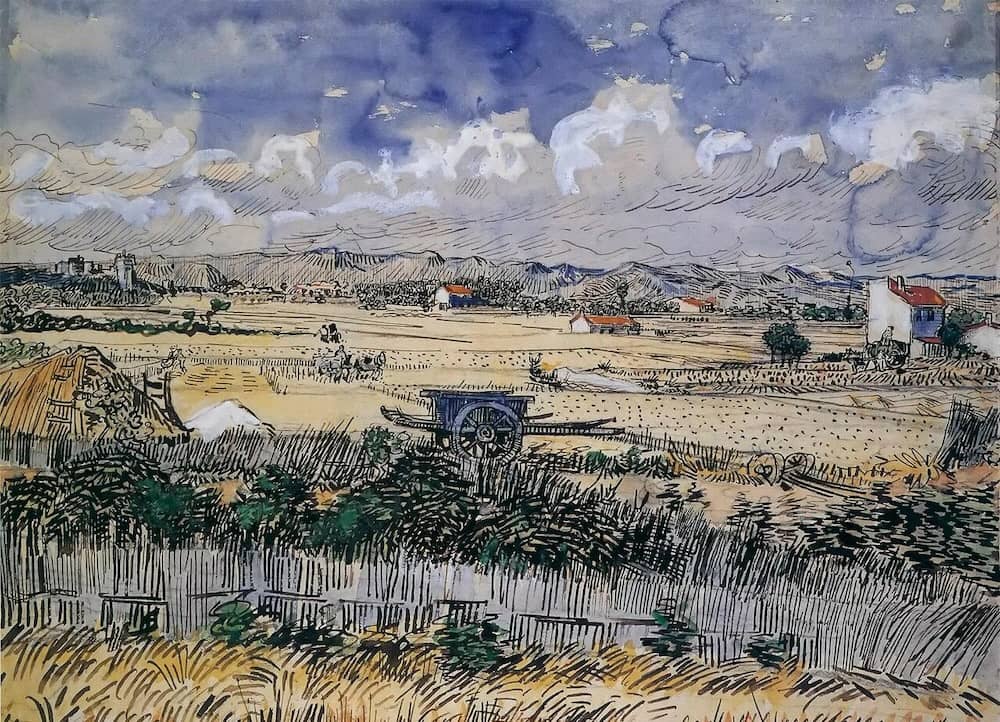
Vincent van Gogh, The Harvest, 1888, oil on canvas

Blue isn't usually such a warm color.  Or is it?  Ciwt has been living in San Francisco's grey windy summer soup for so many years she's out of touch with summer.  So she finds herself coming back to van Gogh's painting of a summer's day in the wheat fields of Arles.  

And to a shift in her understanding of van Gogh's painting regime.  Until now she has thought of him as a sort of early (and Immensely talented!) precursor of the Abstract Expressionist style that dominated New York in the 1950's.  "From my soul to the canvas" was their motto as they stroked animated thick black lines onto huge white canvases (Franz Kline).  Or let thinned paint color stain the canvas into enormous color fields (Helen Frankenthaler).  Or, placed his canvas on the the floor and danced around it with open cans of paint dripping layer upon layer upon layer (Jackson Pollack of course).

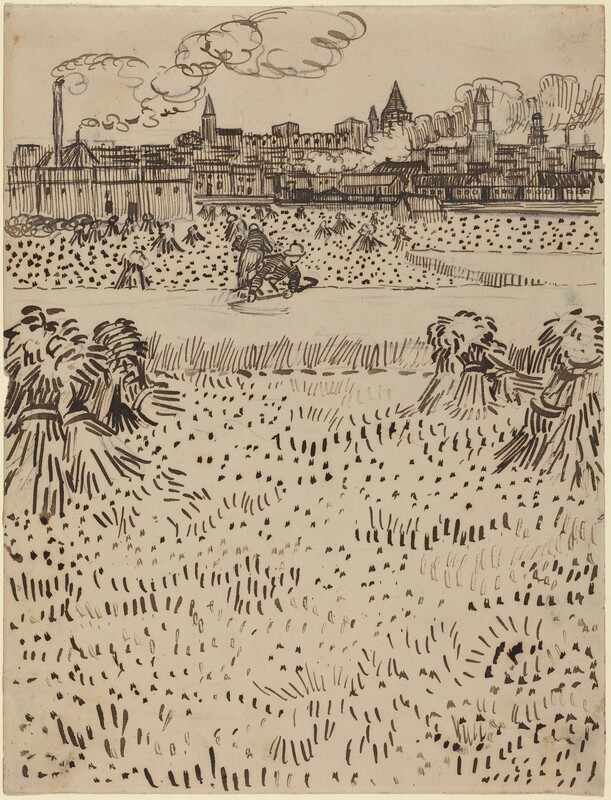
But, no, live and learn, Ciwt.   This "just let it rip" technique was not van Gogh's at all.  Before applying costly oil paint to canvas, he reworked and revised all of his paintings extensively with numerous sketches and painted studies like these: