Walk: Hood
Distance: 3.5 miles
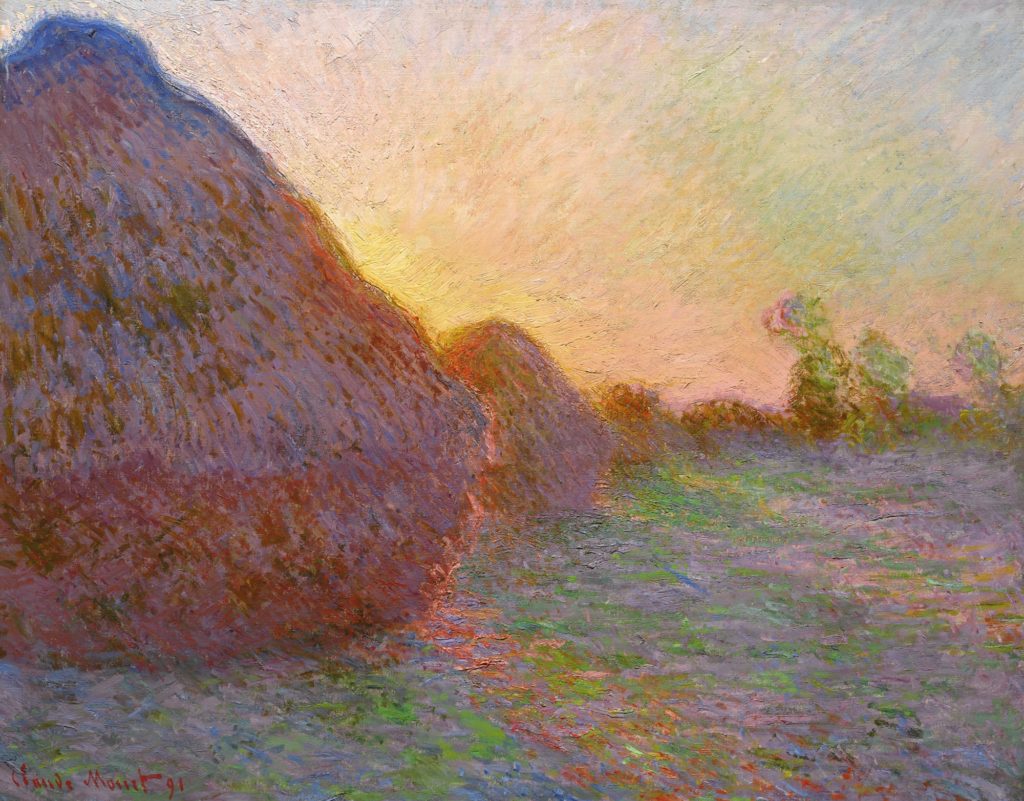 |
| Claude Monet, Meules, 1890, oil on canvas |
Time for a small CIWT break from Ciwt's Neighborhood Halloween contest to visit a beautiful painting and possibly her favorite from Claude Monet's Haystacks series.
It was Monet's grand obsession to capture the atmospheric moods and colors of nature exactly on his canvases. To that end he began the remarkable endeavor of lining up easels outside (en plein air), propping canvases on them, then going from one to the other as nature's light moved through the days and different seasons. His Haystacks series is the most well known and the first one he exhibited. This in 1891 when he permitted the great Impressionist art dealer Paul Durand-Ruel to show 15 of the canvases. Monet likely chose this subject because the haystacks were on a property adjecent to the one and only property he ever owned, his beloved Giverny.
As Monet was advancing the history of art with his development of what came to be known as Impressionism, so engineers were inventing new technologies for working on the hay in those stacks. In order to be useful as food, the seed heads must be separated from the dried grasses in a process known as threshing. Until the end of the 19th century threshing was done by hand with numerous agricultural laborers beating the stalks to force the seeds to fall off. By the 1900's treshing technology had advanced and steam engines became a common power source.
The threshing machines increased speed and efficiency but were also expensive investments for small farmers. Few villages in the French countryside possessed their own thresher, and it was usual practice for groups of farmers to band together and hire a traveling machine . The wait for these machines often took months - grain cut in the summer might lay in the neat and careful stacks all over the Normandy countryside until early the following year.
There were sharply divided sentiments about the thresing machines, with the farmers pleased with the time saving economics and agricultural workers throughout Europe fearing displacement and losing their jobs. And in his artistic world, Monet likely appreciated the stability of the 10-20 foot shaped stacks which allowed him time to explore and develop increasingly mature techniques and color harmonies for his gorgeous Haystack portraits.


No comments:
Post a Comment