Walk: Presidio Pickleball
Distance: 4 miles, 80 minutes pickle

Might be time for Ciwt to say goodbye to pickleball. So much etiquette stuff along with the exercise.
Yes, yes, you've heard this before from Ciwt.......
Walk: Presidio Pickleball
Distance: 4 miles, 80 minutes pickle
Might be time for Ciwt to say goodbye to pickleball. So much etiquette stuff along with the exercise.
Yes, yes, you've heard this before from Ciwt.......
Walk: No, Rainy Day😊 (we need it)
Distance: n/a, yoga
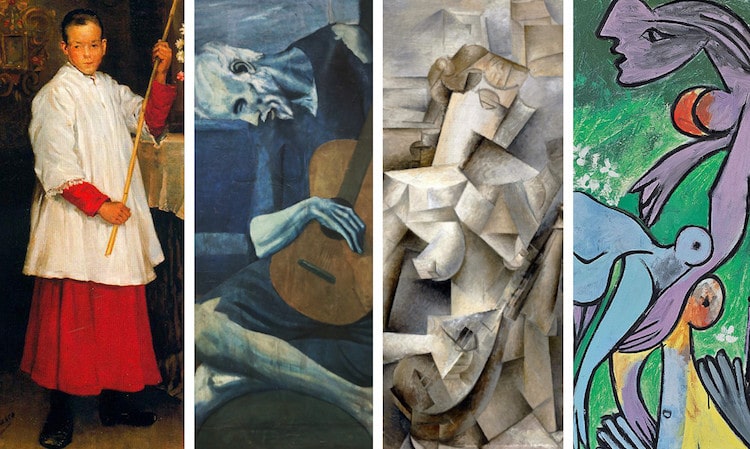 |
| Pablo Picasso 1-4* (partial views) |
So, CIWT readers might remember that Ciwt happens to be taking a sort of symposium on Picasso at the same time a Calder-Picasso show is on exhibit at our de Young Museum. If they have exceptional memories they might remember that Ciwt's first modern art love was Picasso about whose Guernica she did her senior thesis.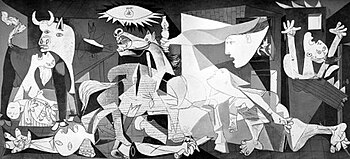 5* It has been nice to be remnded of what her initial excitement was all about.
Art historians, museums and art books usually break his numerous painting styles into periods: Boy Genius realist, Blue Period, Rose Period, African Period, Cubist, Neo-classical, Surrealist to most. This gives the impression that in each period Picasso concentrated on a certain style, stopped that style and then went on to another. You might not be attracted to any of them, but the immense variety of styles he mastered, many totally invented by him, is in itself a wonder and a reason he is regarded as a genius. Beyond that is the remarkable fact that in a single year he might produce a masterpiece in one style one day and in another style the next (or on the same day). And some of those might be sculptures, or prints in a variety of techniques, stage design, ceramics, even poetry and writing.
Such was his near endless talent and prolific artistic virtuosity. Unique virtuosity. Throughout an artist's lifetime, changes in approach, subject matter and style are to be expected. But the extent to which Picasso's style changed in each discipline, particularly painting stands alone among the history of artists.
* 1. The Alter Boy, 1896
2. The Old Guitarist, ca. 1903-1904
3. Girl with a Mandolin, 1910
4. Untitled (from Musee Picasso, Paris), ca. 1927
5. Guernica, 1937
Walk: Very short, Trapped by Turbo Tax
Distance: So little, Yoga

Ciwt is wearing green today even though she's not Irish.
Walk: 1. Monday errands 2. Hood & Presidio Pickleball
Distance: 1. 3.5 miles, Yoga 2. 5.5 miles, 90 minutes pickle
 |
| Discussing Pickleball Line Calls |
Walk: Hood and Presidio Pickleball
Distance: 4.3 miles, 90 minutes pickle
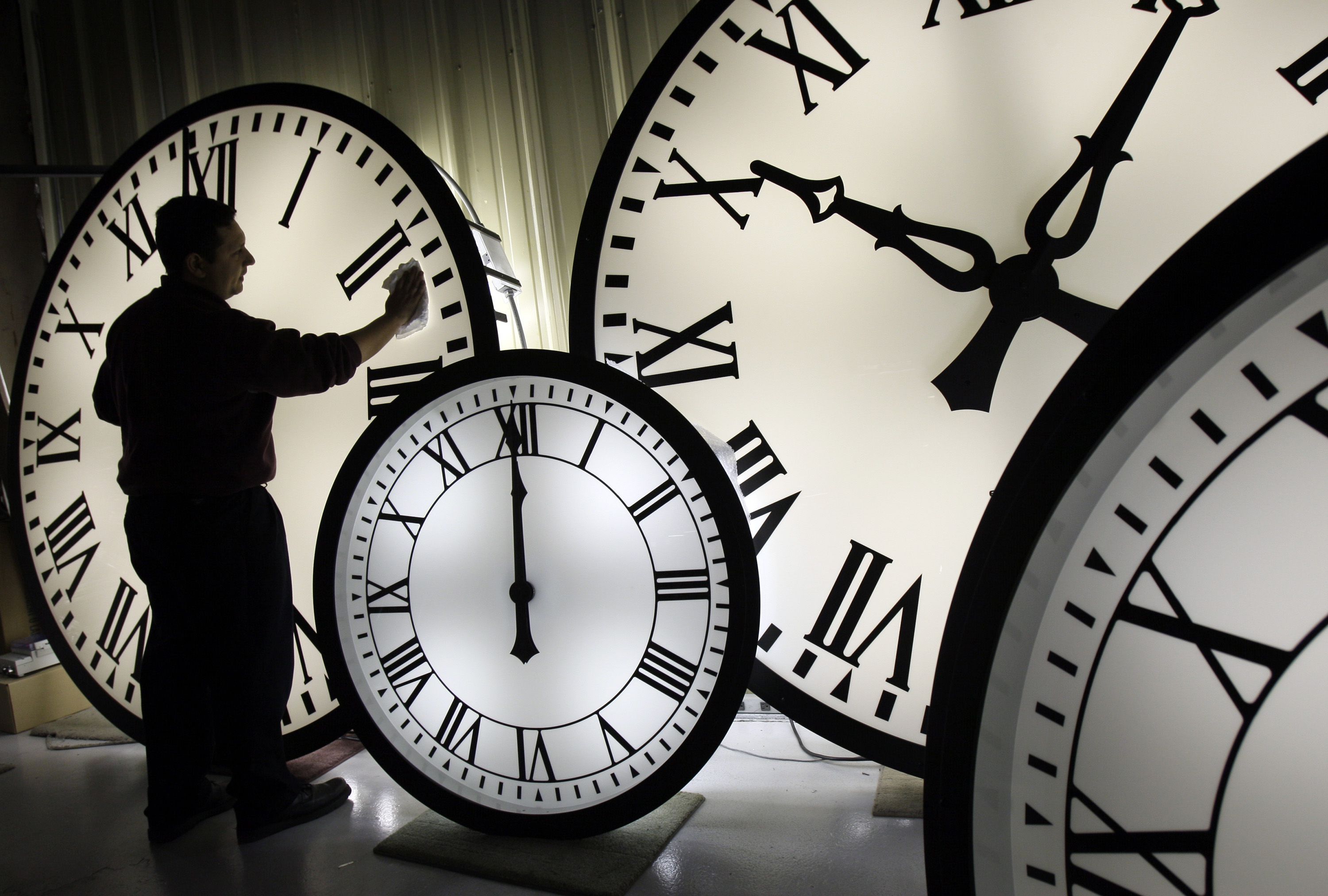
So dark this first morning of Daylight Savings. Were all your clocks set?
Walk: No (again!)
Distance: n/a, Yoga
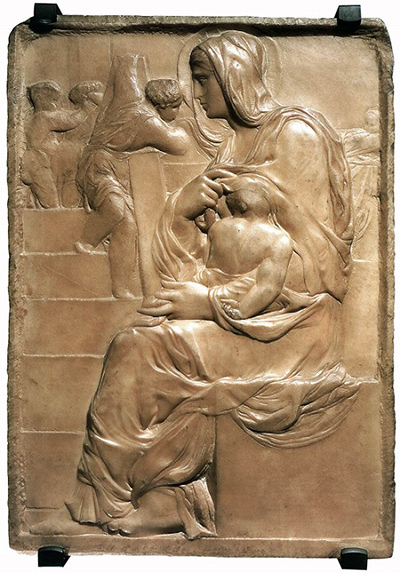
"Every block of stone has a statue inside it and it is the task of the sculptor to release it"
"I saw the angel in the marble and carved until I set it free."
~ Michelangelo (Italian, 1475-1564)
Leaving the 1900's of Calder and Picasso, both of whom are celebrated for their sculptures, Ciwt's thoughts move to arguably (if anybody actually would) the greatest sculptor who ever lived: Michelangelo di Lodovico Buonarroti Simoni, best known simply as Michelangelo. And to a few things Ciwt learned about him recently.
First, biographically, she didn't know that he grew up, after the death of his mother, with his nanny and her husband who was a stone cutter. Or that Michelangelo's father owned a marble quarry so that the young boy spent a great deal of time watching stone being quarried and carved as well as acquiring hands-on experience with the stone at an early age. He also sought out the company of significant artists and worked in his early teens as an apprentice to one of the master painters who had been hired by the Vatican to decorate the walls of the Sistine Chapel.
Second, in terms of his technique. Like many people Ciwt is familiar with the two famous quotes from Michelangelo above. Because of them she has carried an image of the sculptor standing in front of a block of marble and artfully chipping away until he began to sense a presence inside. And then gradually, carefully, laboriously continuing until, OMG, David! Or, secondarily, that Michelangelo looked at a block of marble, sensed what figure was in it, and carved away "until he set it free." In both cases, the figure inside would have been a revelation to Michelangelo.
Turns out, yes, Michelangelo saw sculpture as the art of taking away to bring the form below into existance. But, no, the look of the form was not a surprise to him. Even before, and certainly in the multi year process of actually carving, he produced detailed sketches - over 900 of them remain. The drawings are imbued with technical skill but, beyond that, with his own spiritual passion and desire to work with the marble to bring the soul of his subject to life.
No higher goals for himself can be imagined, and the wonder is that he actually achieved them - at an early age. During his twenties! he produced two of the world's greatest sculptural masterpieces, Pieta and David. At the time the life and emotion he had brought to the grieving mother and the depiction of the human form he achieved with David were beyond ground breaking, beyond a revelation. Nearly 450 years after his death in 1564 his work is as wondrous as it was at the time, remains ground breaking and is still the gold standard sculptors aim for.
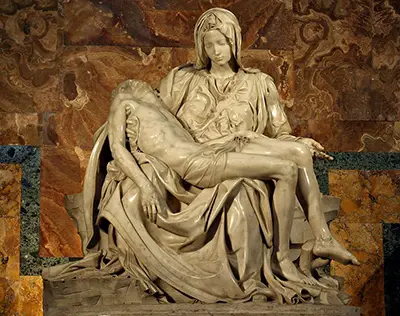 |
| Micheangelo, Pieta, 1498-99, Carrara marble and then the very next year he began David |
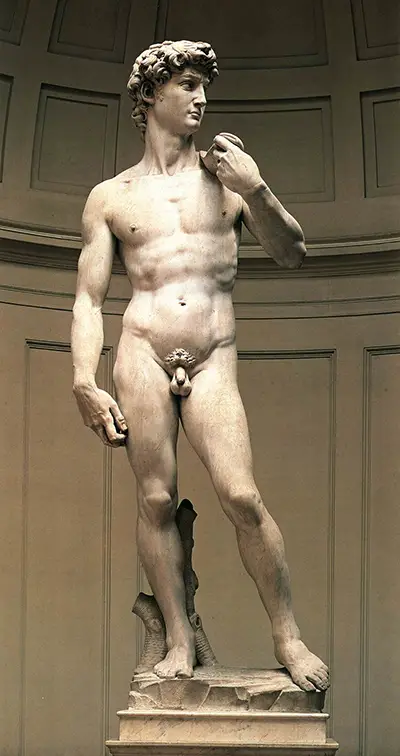 |
| Michelangelo, David, 1501-1504, Marble |
Walk: 1. Hood 2. No
Distance: 1. 3.5 miles, Yoga 2. n/a

Walk: Legion of Honor
Distance: 2.4 miles, Yoga
So, today/Wednesdays Ciwt needs to be out of her place for a few hours while it is being cleaned for her and her cats. Thunderstorms were predicted, but she wasn't concerned because she had a confirmed reservation at the Legion of Honor. She'd had the de Young Museum nearly to herself last week and was looking forward to something similar at the Legion today. Just her, quiet, and all that art.

When she arrived, oh boy, empty parking lot. Things were looking good for a totally private, art-communing experience!

She was a bit early for her confirmed reservation so she walked around to the rarely viewed back of the Beaux Arts building. Beautiful. The entire museum is a three-quarter scale adaptation of the Palais de la Legion d'Honneur in Paris. Permission needed to be given by the French Government for it to be built on its site in San Francisco in the early 1900's. A local architect then incorporated the most advanced ideas in museum construction, including thick walls with hollow tiles to keep temperatures even.
A major renovation in the mid-1990's that included seismic strengthening and a large underground expansion added a wonderful cafeteria and increased visitor and program facilities without altering the historic facade.

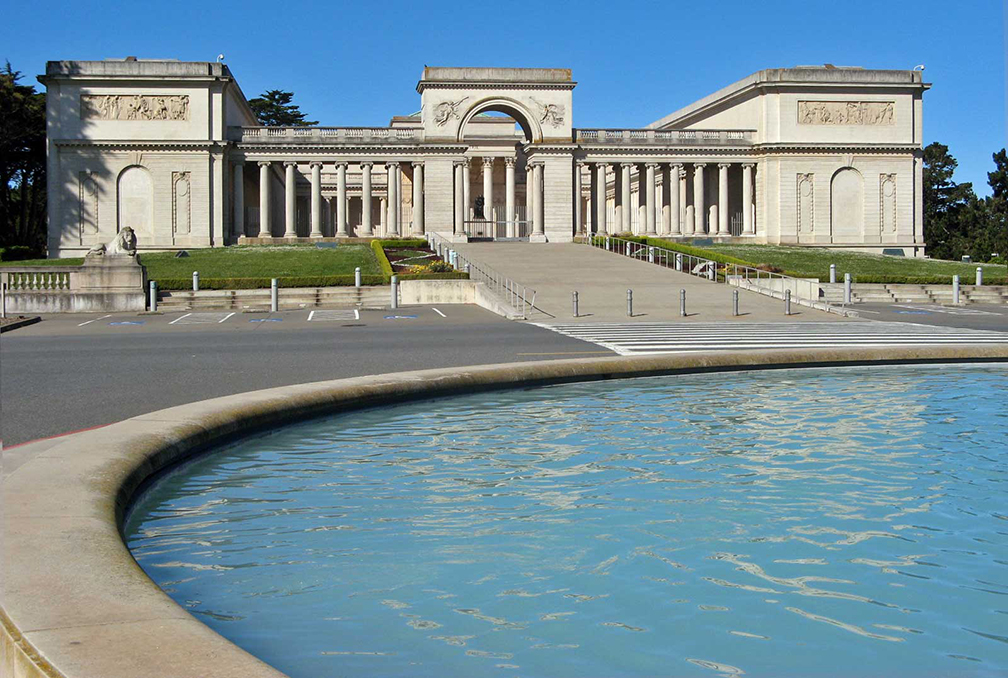
Then at the appointed hour, she went back front to the grand entrance, walked up the ramp and.....