Friday, January 8, 2021

Hello Again, Creatures --- Day 9/263

Walk: Hood in Drizzle (any moisture is welcome)

Distance: 3.5 miles

Original Cover


Ciwt was reminded today of this favorite book from her youth, well her younger years at least.  James Herriot's compilation of heartwarming stories is based on the people and animals he met during his early years as an English veternarian.  

Now that it has become a massive hit both in bookstores and on television and the big screen, it is quaint to recall it actually had quite a sleepy start.  In England at the time of its publication (under another title), veternarian surgeons were heavily discouraged from writing books under their own names. To be published at all, James Alfred Wight adopted the Herriot pen name.  But, even then, sales were so slow his book might have died there if an editor from St. Martin's Press New York hadn't believed in it.  And when it was published in the States in 1972, it took off with far less than best seller momentum; Ciwt remembers being told by a friend about it, and then she told one or two friends, and so on and so on across the country.

At this point who isn't acquainted with and fond of Herriot's creatures, towns and townfold and who won't be happy to hear that PBS is bringing back a new 7-part series this Sunday?


Thursday, January 7, 2021

Untitled --- Day 9/261

Walk: No, Reading/Escaping

Distance: n/a, small yoga


CIWT is not a go to place for any political comments.  But it is for every day art, and Ciwt thinks this photo is quite amazing.

Wednesday, January 6, 2021

Yes, Happy Artist --- Day 9/260

Walk: Hood (to get away from DC mayhem)

Distance: 1.5 miles, yoga

Alexander Calder (1898-1976), Mobile, Triumphant Red, 1959-65, rod, painted sheet metal, wire, 


We are so used to hearing about struggling artists or starving artists that 'happy artist' seems a contradiction in terms.  But Alexander Calder, known as Sandy by family and friends, truly was one. Lifelong.  

Today he is best known for his mobiles and stabiles, but they came later in his career.  His playful and joyful artistic expressions began in childhood when he begged his parents for and was given his own home studio. He would spend hours with his first artistic tool, a pair of pliers and whatever objects might be around.  By age eight, he was already creating jewelry for his sister's dolls from beads and copper wire, and he went on to the making of small animals and board games from scavaged wood and brass.  

Calder left the studio of his youth to become an engineer specializing in mechanical engineering and applied kinetics.  His heart was always in being an artist, but his parents and grandparents, who were all artists, feared with good reason for his financial prospects.  So after graduation he tried to avoid his calling and worked in such jobs as automotive engineer, steam boat stoker and illustrator for the Police Gazette, eventually enroling in evening art classes.  At least two life changing experiences came of  these.  First, the boat allowed him many hours to contemplate movements of the planets from its deck, and to question how the constant motion of the universe could be incorporated into static art.  Second, a bit later the Gazette gave him an assignment to illustrate acts at Ringling Brothers Barnum and Bailey circus.

The circus was colorful, spectaular, a child's delight and Calder fell in love with it.  It was also an art form in constant motion and stoked Calder's quest to combine movement and fine art.  Propelled by these two energies he finally determined to make art his life work and moved to Paris.  Soon after arrival he was using those pliers and everything at hand - wood, metal, cardboard, paper, yarn, string, buttons and more - to create a circus with miniature animals, acrobats and other perfomers to create his own circus.  His manual dexterity was astounding in itself, but the true wonder was his use of pullies and springs so that his little people and beasts moved.  

He was also expressing the whimsical, playful wit that infuses all his art.  Shortly his love of performance surfaced and he was regaling his new French friends with circus shows.*  'Amis' such as Marcel DuChamps and Jean Arp attended, loved Calder's circus and became lifelong friends.  And from his circus and Paris days, Calder returned to the U.S. and went on to be Alexander Calder, creator of mobiles and stabiles, while remaining a happy soul thoughout his life.

Alexander Calder, Circus, 1926-1931, Painted Wood, cloth, rubbing tubing, wire, nails, fur, pipe cleaner, cork


Alexander Calder, Elephant Trainer and Elephant, from Circus, 1926-31,


*Calder performing his circus , 1927  

Tuesday, January 5, 2021

Happy Space --- Day 9/259

Walk: Presidio Pickleball

Distance: 3 miles, 2 hours pickle

Ciwt (and her readers probably) is thinking Enough Already with the snow.  There are other things above like Alexander's charming, playful, happy mobiles and stabiles.

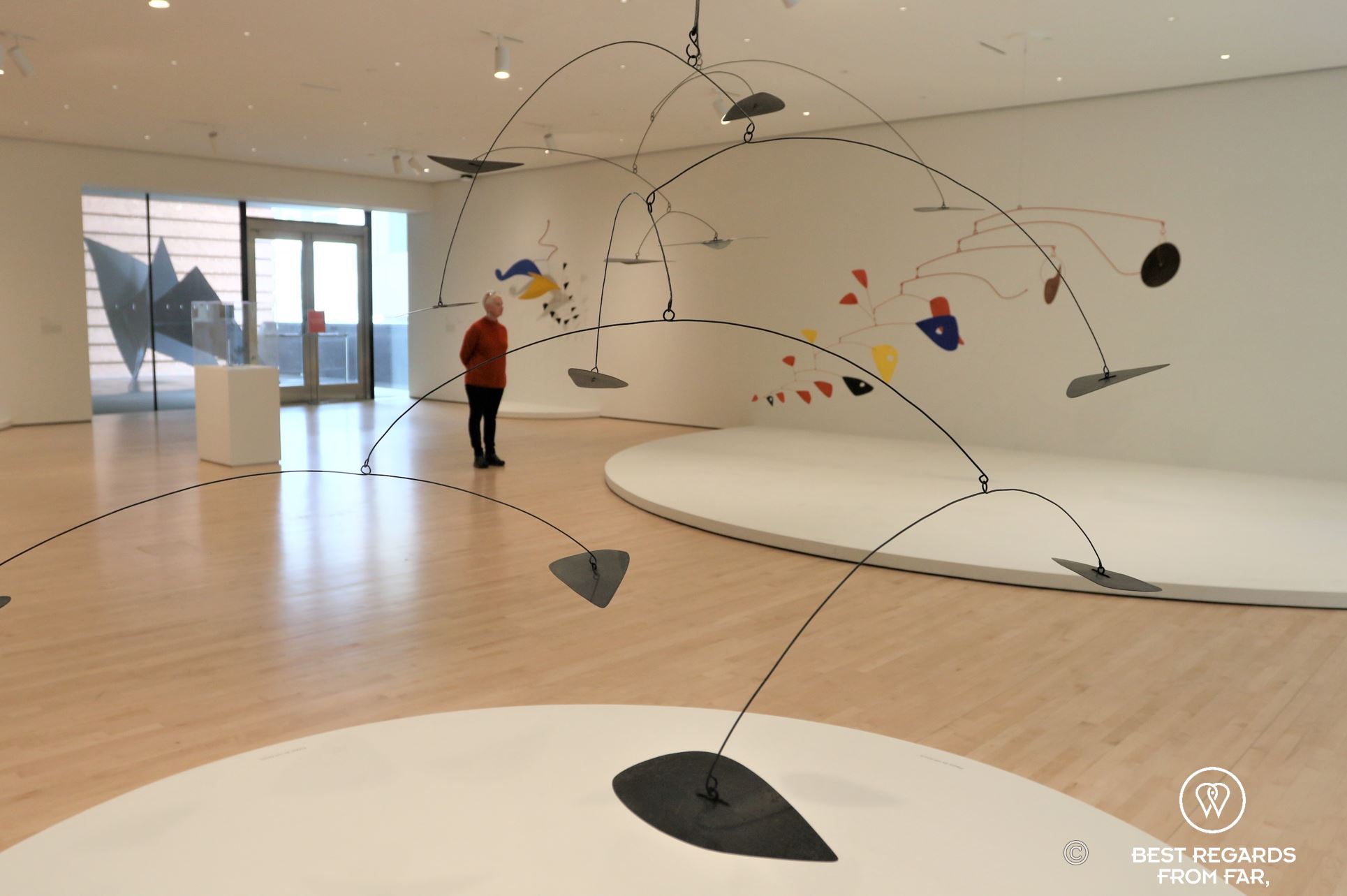
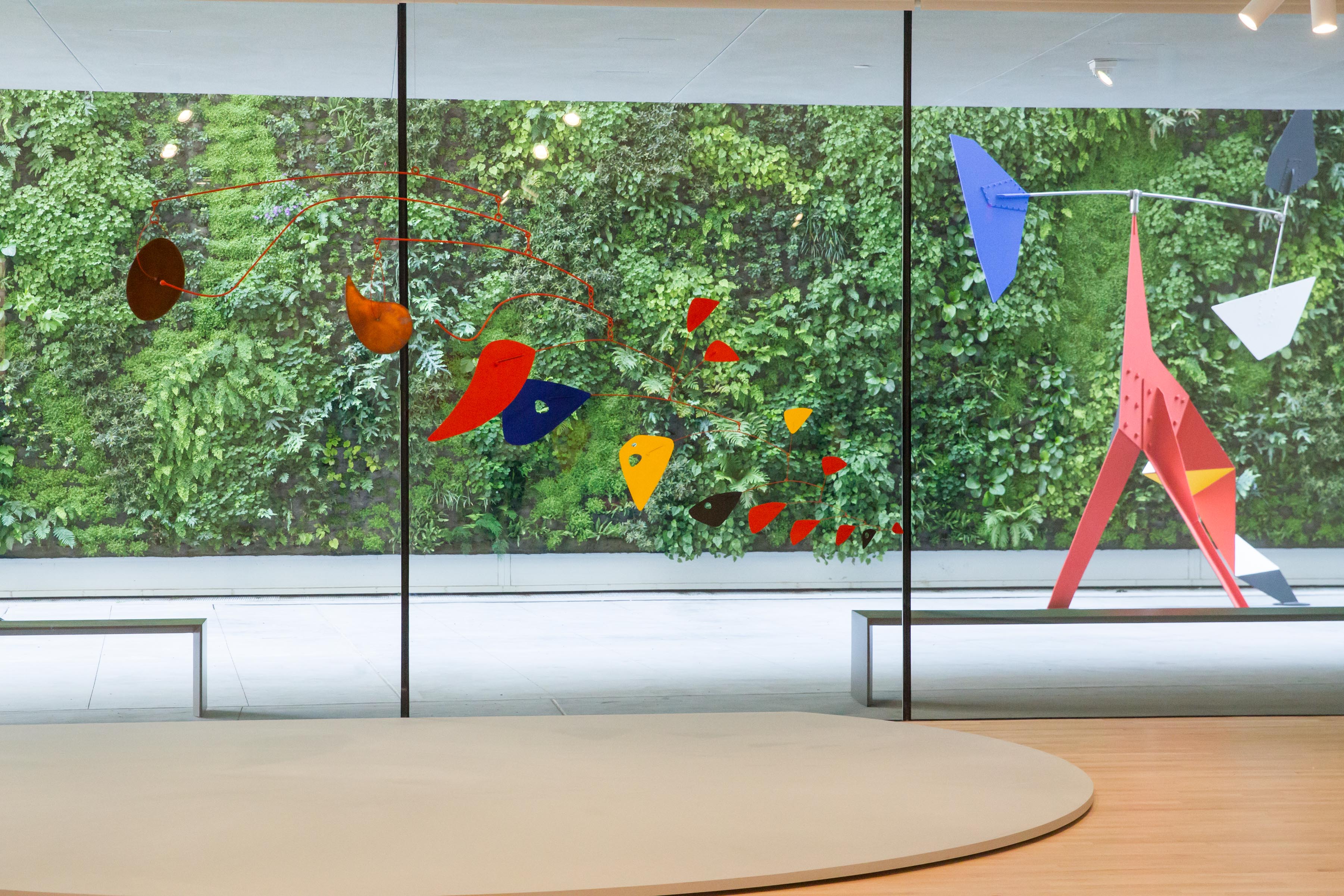
Alexander Calder Room at SFMOMA

Alexander Calder Room at SFMOMA


Occasionally when Ciwt gives an art tour, a client will ask to see some of her favorites.  At SFMOMA she always includes the spacious, airy Alexander Calder room filled inside and out with a selection of his mobiles and stabiles gracefully in motion.  Behind the sculptures on the deck is an enormous living wall constant and soothing in its greenery.  It is just a totally happy space to be in and a perfect homage to a totally happy (really!) artist.  More on him tomorrow......


cc

Monday, January 4, 2021

Winter Comes to Cities Too --- Day 9/258

Walk: Hood  ( after needed Rain 😊)

Distance: 3 miles, Yoga

Gustave Caillebotte, Rooftops in the Snow, 1878, 32" x 26," o/c Musée d’Orsay, Paris.

detail

Landscapes were not a well regarded art genre in 1878.  Land was where people toiled from pre-dawn often to late into dark.  It was the unpredictable, difficult, often dangerous source of existence, not a subject of contemplation or reverie.  And, if landscapes were anything, they were rural - especially snow scenes. 

So you can imagine how modern this urban snow scene appeared to the viewing public when Gustave Caillebotte, presented it at the fourth Impressionist Exhibition. So modern in fact that there is little record of comment or critical review of it.  Ciwt has the sense people just kind of walked on by.  They did like and stop before his portraits and boating scenes (for good reason!). 

Skiffs on the Yerres, 1877

But the main parts of  Haussmann's vast renovation of Paris  (1853-1870) were only recently completed.  The Parisians had been subjected to decades of dislocation, demolition, massive inconvenience and turmoil.  It is understandable that few beyond Caillebotte might have embraced the new visuals, the steep architecture, the wide boulevards, the parks, the doubling of the city's size.  

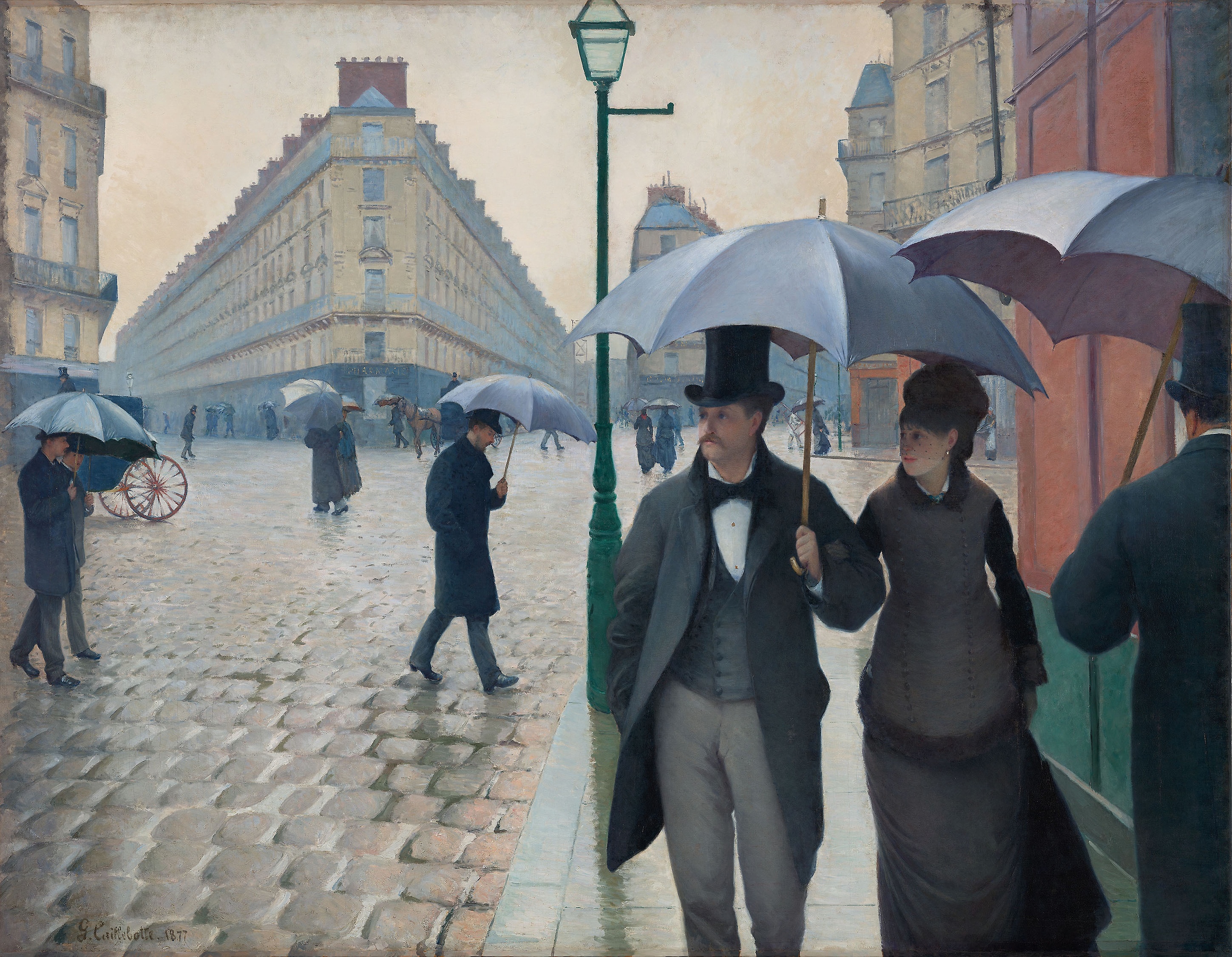
But Caillebotte was clearly captivated with Paris's look and enthusiastically turned his attention to how the light, weather and seasons affected the atmosphere and human activities of this new urban landscape.  In the process he created some of the most thrilling and admired cityscapes in art history.

Paris Street, Rainy Day, 1877

The Floor Scrapers, 1875


Sunday, January 3, 2021

Another Great Reason for Winter --- Day 9/257

 Walk: Presidio Pickleball

Distance: 2.5 miles, 2 hours pickle, Yoga stretch


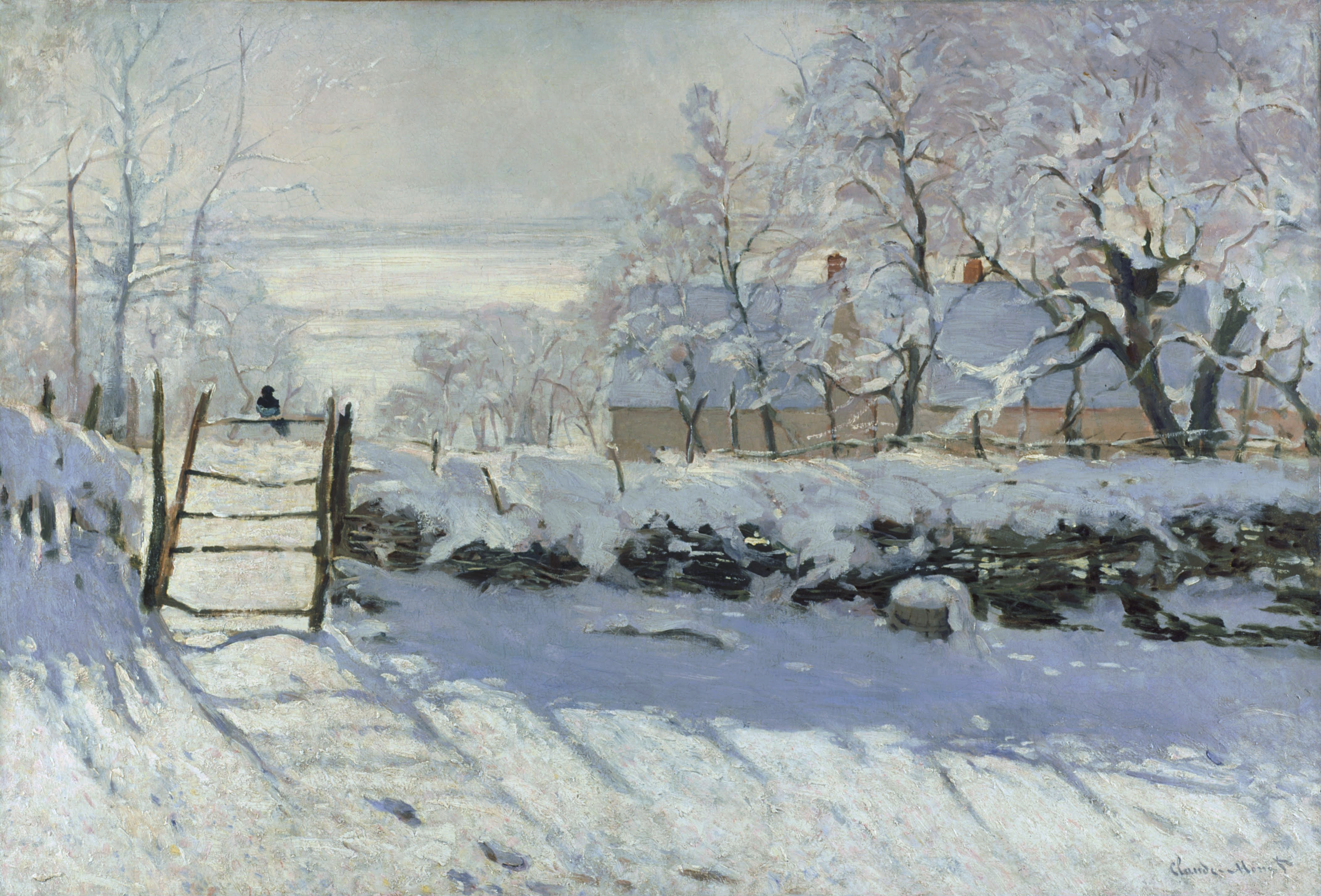
Claude Monet (1840-1926) , The Magpie, 1868-1869, 3' x 4.3' , o/c, Musee d'Orsay
 
detail

Winter has its own rewards, and, for Ciwt, one of them is that it produced the day Claude Monet painted The Magpie. At once universal and highly personal, it is one of her favorite art works. As a solitaire herself, she relates deeply to that single bird, and everyone who has woken to the soft, hushed glow of morning after a snowstorm is brought back to it viewing this work. 

The Magpie's restful simplicity belies the physical and creative challenges Monet undertook to create it.  Freezing cold for one.  Most landscape artists before (and after) him would make sketches outdoors and then return to their studios to paint the final work.  But Monet was so obsessed with capturing nature exactly that he painted entirely outdoors, often from predawn to the end of day.  The average temperature in Normandy, France, where The Magpie was painted, hovers around freezing.  A French journalist happened to see him one day and described the scene: We have only seen him once. It was in the winter, during several days of snow, when communications were virtually at a standstill. It was cold enough to split stones. We noticed a foot-warmer, then an easel, then a man, swathed in three coats, his hands in gloves, his face half-frozen. It was M. Monet, studying a snow effect.[11]  
 
Monet himself was apparently so caught up in, even exhilarated, by his quest that he once wrote a friend:  I painted part of the day today, while it was snowing continually: you would have laughed to see me entirely white, my beard covered with icy stalactites.

So it was a physical feat for Monet to paint his snowscenes, but it is the artistic breakthrough they represented which stunned and still holds the art world's attention. Monet captured snow!  This hadn't been done so successfully before him.  Snow like the sea (which he is also a master at painting) is elusive.  As light plays with it, it is actually many colors;  pale, it is also luminous; its shadows are not black but, as Monet realized, the convention-shocking blue of The Magpie.  Snow is so challenging that even with his work before their eyes, artists were (and are) hard put to equal Monet's feat. In the late 1870's his friend and famous artist, Edouard Manet, tried to paint a snow scene but gave up exclaiming "No one can do this like Monet!"

In some ways Monet was the sole bird of his painting.  Although a smattering his 'renegade' artist friends recognized the novelty and daring of The Magpie, its initial reception is sadly typical of his impoverished twenty year struggle for recognition. The Royal Academy powers that be in Paris and, consequently the French public whose tastes were entirely formed by them, were flabbergasted by the unorthodox 'paleness' of the work and turned it down flat for the 1869 salon. 

Now of course Monet is that 'rare bird' who not only achieved grand success in his lifetime and is known as the Father of Impressionism but whose reputation and following continues to grow and whose works - including The Magpie - count among the most beloved in history.

Saturday, January 2, 2021

Let There Be Winter --- Day 9/256

Walk: No, Rain (yay) and cold

Distance: n/a, Yoga


Pieter Bruegel the Elder, Hunters in the Snow, 1565, oil on wood, 5/3' x 3.8'


Leave it to Ciwt, a cold weather girl transplanted to California, to romanticize winter as the year begins. But, really, who cannot be completely drawn to this heartwarming winter scene painted so long ago but still so alive?


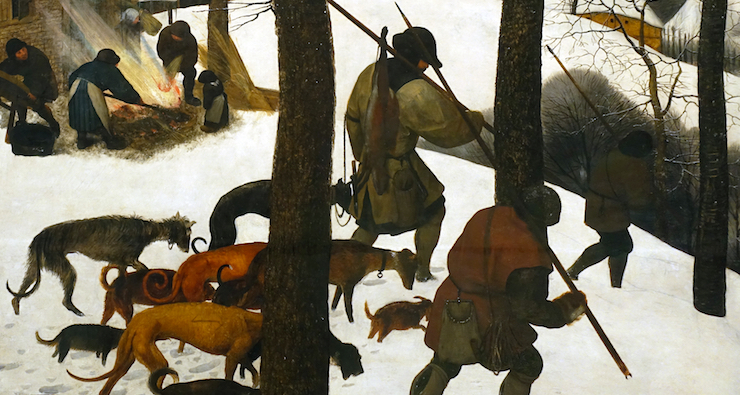
The world of the painting is locked in winter but teeming with life as huntes and their dogs bring in game for winter provisions  


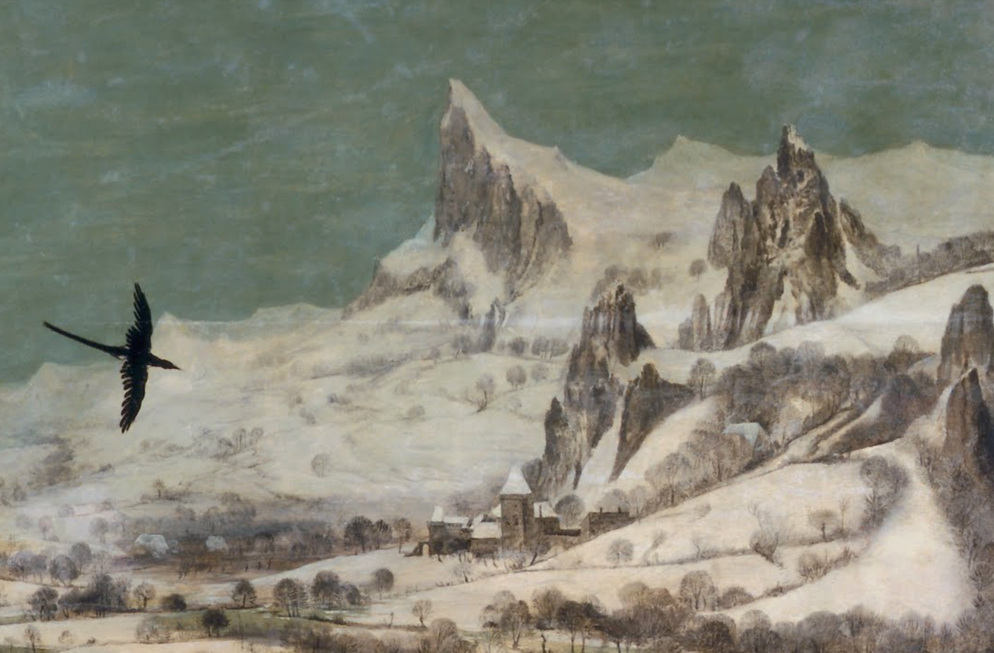
Crows circle the sky         


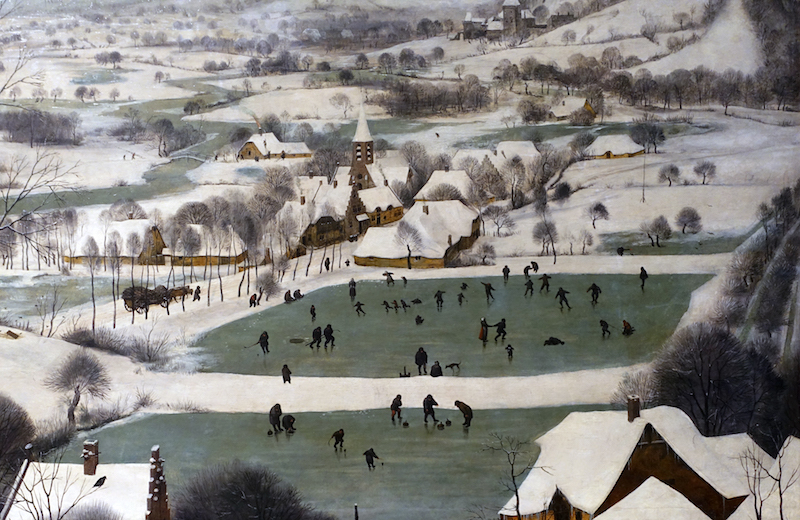
Villagers skate on a frozen pond   
 

One of the most beloved and reproduced paintings in the world, Hunters in the Snow is also one of European art's first widely accepted genre painting focusing on the life, rituals, pastimes of peasants as well as the architecture and landscape of the surrounding village.  And its artist, Pieter Bruegel the Elder (Dutch, ca. 1525/30 - 1569) was truly the pioneer of this form which precisely recorded details of a now vanished folk culture and also paved the way for the explosion of genre and landscape painting to this day. 

But, if you spend time with Hunters in the Snow, you realize Bruegel has more in mind than re-creating every day peasant life. He has actually transformed the landscape. The Dutch landscape is flat with much of it below sea level, but that crow is flying before steep alpine cliffs. No peasant himself, Bruegel was a highly trained, brilliant artist and sophisticated world traveler.  He was was also a learned humanist patronized mainly by scholars, weathy businessmen and prominent humanists such as cartographers and humanists.  His vision was exceedingly complex, expansive, and his use of landscape itself to communicate an atmospheric, universal vision of the world was a first and ultimately his greatest artistic legacy.  

Or forget all this just let your heart be warmed by his wonderful art work......


Friday, January 1, 2021

2021 --- Day 9/255

Walk: Presidio Pickleball

Distance: 3 miles, 90 minutes pickle